
Introduction
Some may mock the humble “vibe coder” and say they lack real programming experience, but the future of vibe coding is here. I remember poring over C++ manuals, writing and compiling code in Bloodshed, only to have it fail when I clicked “Run.” Then came the painstaking debugging process, which made learning even more frustrating.
It remains to be seen whether AI will make programming obsolete. Personally, I doubt it. Someone still must review the code, approve it, and make it faster and more efficient. At its current stage, AI still requires human input. Public versions of the platform are not yet able to operate autonomously or combine data as humans do.
Sola’s Blue AI now brings an artist’s vision to life for non-engineers. This cutting-edge AI-powered platform accepts instructions in plain English and Japanese and turns them into working apps in just minutes. Future articles will focus heavily on Blue AI where we’ll provide tutorials. As a vibe coder myself, I’ll show how little programming experience is needed for big results. The first step is to visit the Blue AI Homepage and get signed up. Let’s get into it!
Pricing
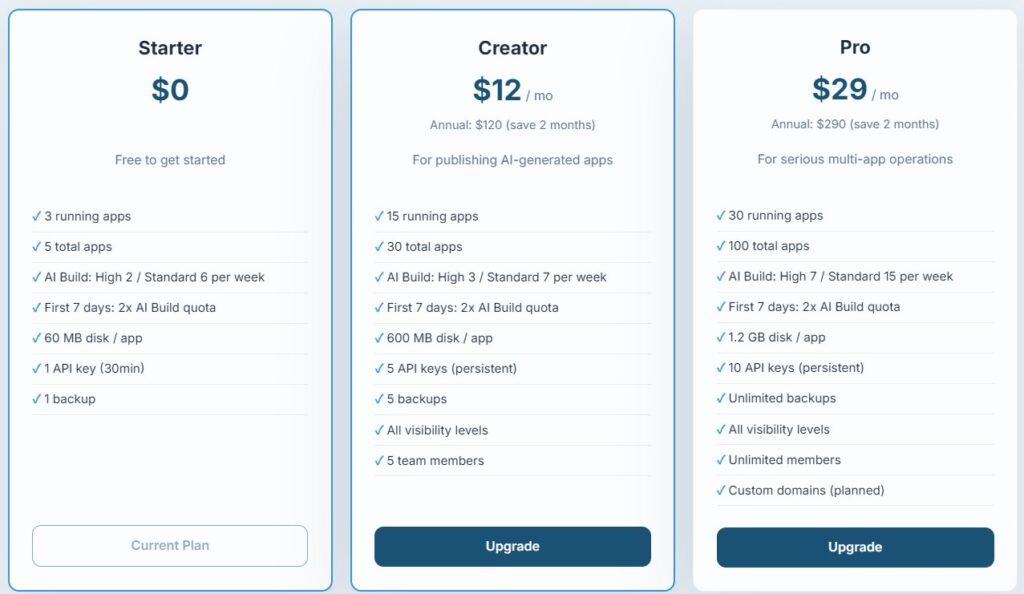
Below is a screenshot of Blue AI’s pricing. Once you register and reach the homepage, free users will see the following: [High 0/2 Standard 0/12 Weekly resets MM/DD]. Those are the weekly app-production runs available on the free plan.
So far, I’ve found the free version generous and a good way to get familiar with the platform and begin understanding how Blue turns the user’s ideas into fully functioning apps. For those who need more apps and greater functionality, Blue’s pricing is reasonable. Annual billing even includes two months free.
Start here
From the Blue AI homepage, click Console in the navigation bar, then Blue AI Build near the bottom of the left-hand column under Other. This opens a tutorial of sorts. Under the words Start here are six starter templates meant to be approachable for non-engineers.
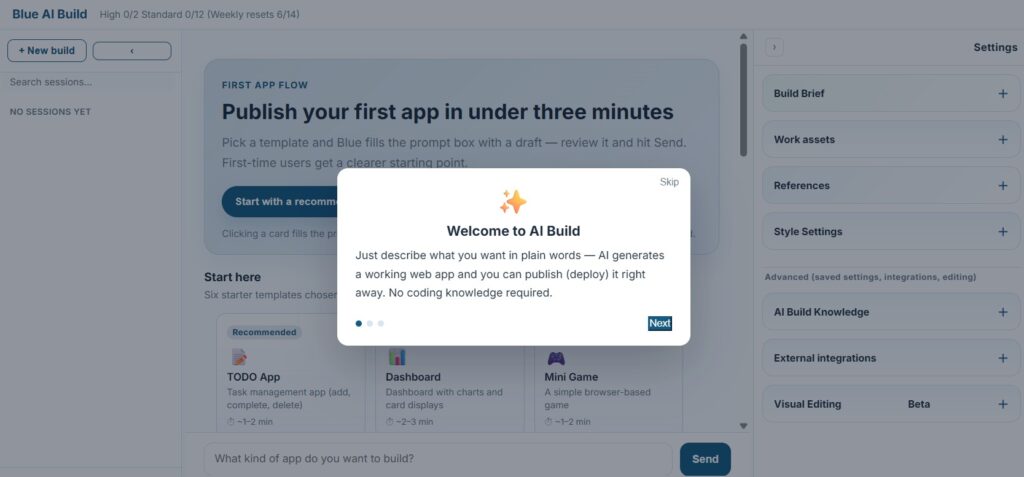
All the programming instructions appear in the chat box at the bottom of the page. Clicking Portfolio, for example, fills the chat box with sample text that Blue AI will use to build the app. Here’s the sample language:
[Build a portfolio site. Requirements: hero section (name, title, tagline, gradient background), About section, skills list (5 items with progress bars), project showcase (3 cards with image placeholder, title, description, tech tags), contact form (name, email, message). Smooth-scroll navigation bar. Modern design, fully responsive.]
Trial Run
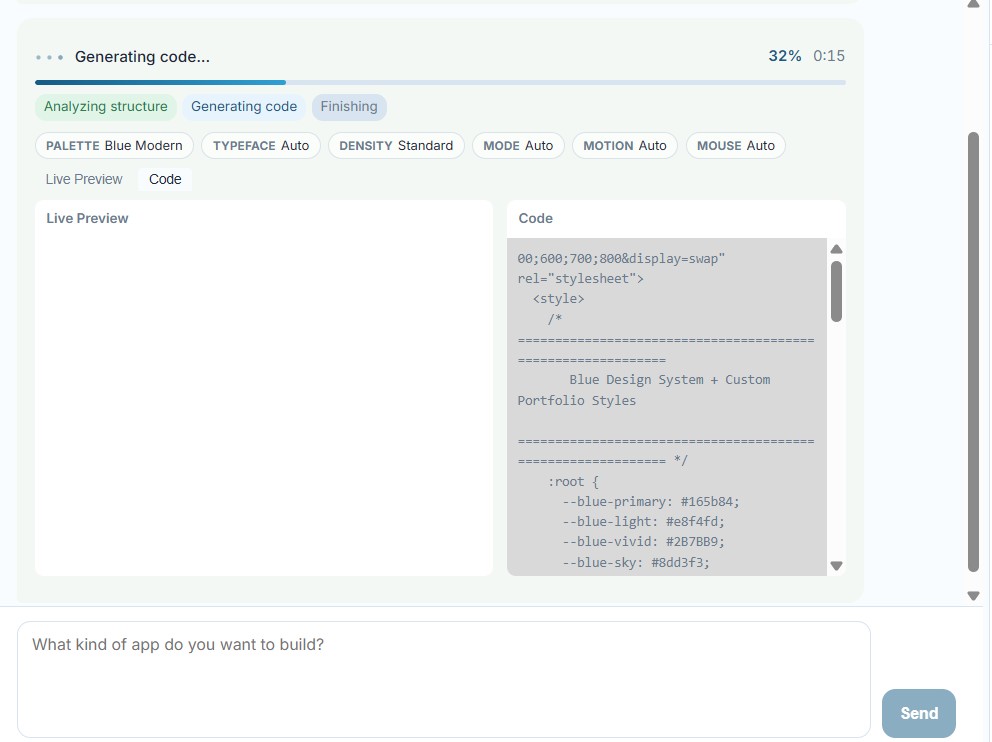
For this first example, I left the sample instructions unchanged. After clicking Send, Blue AI starts generating the requested site. I do not have a particularly fast PC, and the site completed in under four minutes from start to finish.
One of the most interesting parts of the process is the live code written in the Code box. As the app builds, you watch Blue AI create an entire website from scratch, writing the HTML, CSS, and interactive JavaScript in real time.
Author’s Subscriber Lottery App
The second example in this article is a giveaway randomizer for content creators. The idea came to me years ago: an award system for longtime subscribers who receive exclusive content. Substack authors and their monthly subscribers are one example.
Suppose the creator wants to run a giveaway, or perhaps they write about small businesses and want to showcase one premium subscriber’s business as a bonus. For this second Blue AI-generated app, the goal is to give each user one lottery ticket for every month subscribed. For example, a subscriber from January to September would have nine entries. A user subscribed from March to May would have three entries.
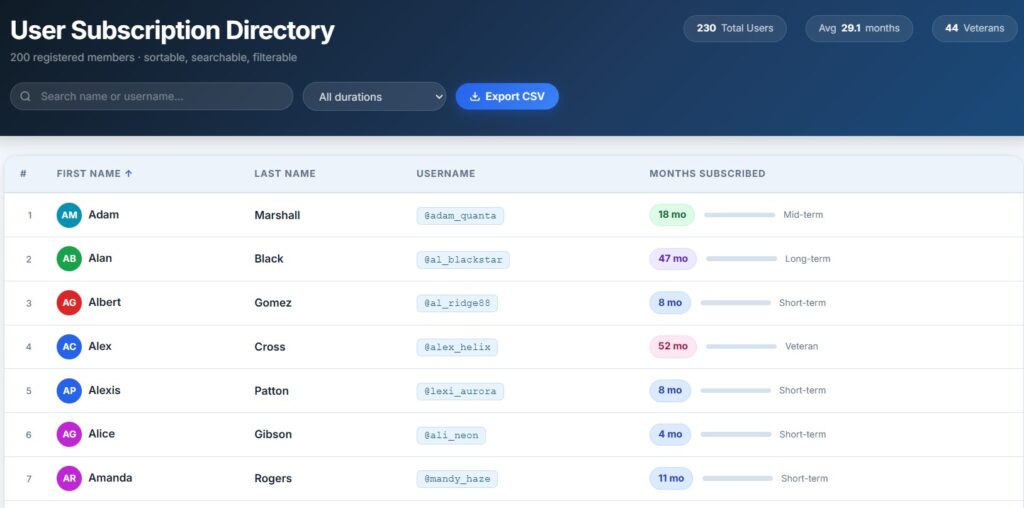
Random Data Generation
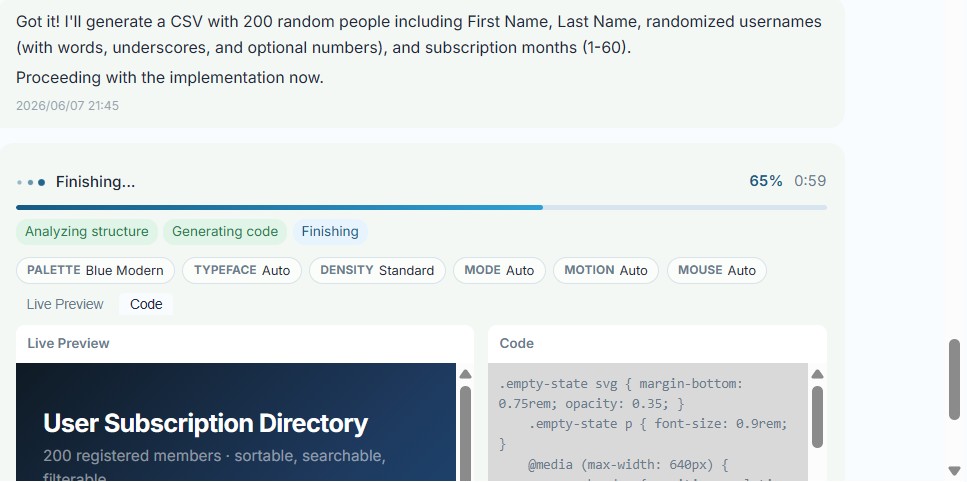
Let’s have Blue AI generate a random list of fictitious subscribers and corresponding subscription length to use in our second lottery app. Here’s the text prompt:
[Generate a random list with two-hundred common English names. Using different columns for each data point starting with First Name and Last Name. The next column should be that person’s username, which will also be randomized by a series of sensical or non-sensical words, underscore, with or without numbers anywhere in the username. Another column will list months subscribed. Assign a number value to the month’s subscribed column which could be a few a 1 month or 60 months if the user was subscribed for 5 years. Do not exceed 60 months for total subscription months.]
Lottery App
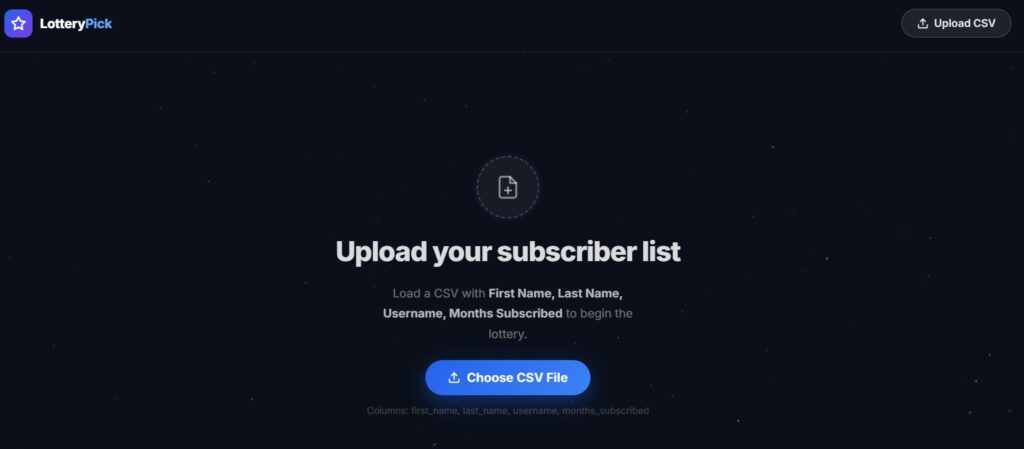
After completing the random names, usernames, and subscription lengths, it was time to create the lottery app. I used the following prompt to build the second app, which chooses a subscriber for a giveaway. It’s important to remember describing the desired output in both a succinct, but detailed manner. While the AI can its own design decisions, results will improve significantly with clearer direction. Here is the prompt:
[Generate an app that allows the user to upload a CSV with first name, last name, username, and number of months subscribed. The app should randomly select a user and declare that user the winner. The app will create one entry for each user for each month subscribed. For example, if one user has been subscribed for 18 months, that username will have 18 entries in the lottery app.
In the upper-right corner, include an “Upload CSV” button. After the file is uploaded, a large button in the center of the screen labeled “PICK A WINNER” should change from a dull color to a brighter one when clicked. The app should then pick a user at random and display the username with a large “WINNER” in the center of the screen. While the app determines the winner, it should show a spinning wheel or similar visual indicator to build suspense.]
Conclusion
This may be the most fun article I’ve ever written. I was impressed by Blue AI’s ability to turn plain-English build instructions into a working app. Any interested readers should register on the Blue AI Homepage and begin experimenting for themselves.
In the new age of AI, the only limit is your imagination, it seems. Next article we’ll be discussion Application Programmable Interfaces (API) and how Blue AI could forge the missing link between two critical pieces of software with no coding experience required by the user. Catch you next time!